 +1-3236076188
 sales@marketmonitorglobal.com

 Log In
 Log In
Home>News>Energy Storage Liquid Cooling Pumps Market to Reach US$177.06 Million by 2032, Led by Concentric, Rheinmetall and Sanhua in a Moderately Fragmented Competitive Landscape
Energy Storage Liquid Cooling Pumps Market to Reach US$177.06 Million by 2032, Led by Concentric, Rheinmetall and Sanhua in a Moderately Fragmented Competitive Landscape
Wednesday,18 Nov,2026
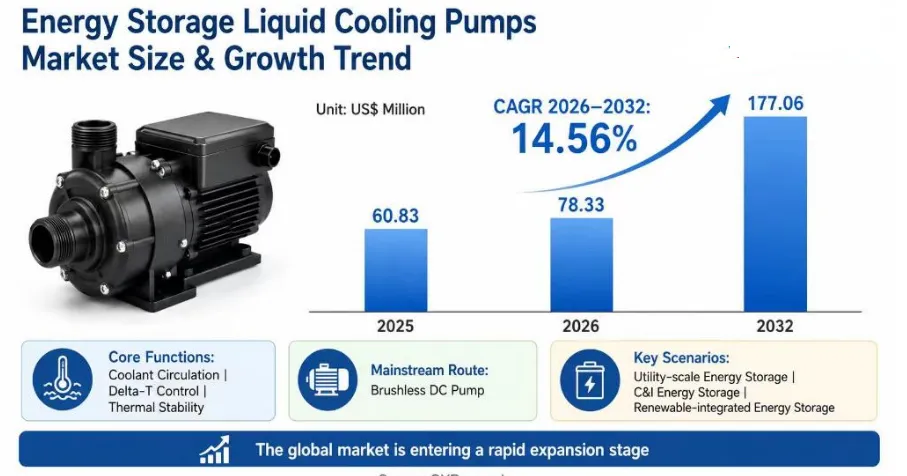
Energy Storage Liquid Cooling Pumps Market to Reach US$177.06 Million by 2032, Led by Concentric, Rheinmetall and Sanhua in a Moderately Fragmented Competitive LandscapeThe global Energy Storage Liquid Cooling Pumps market was valued at approximately US$60.83 million in 2025** and is projected to reach **US$177.06 million by 2032, expanding at a CAGR of 14.56% during 2026–2032, according to Market Monitor global’s report Global Energy Storage Liquid Cooling Pumps Market 2026 by Manufacturers, Regions, Type and Application, Forecast to 2032. The 2026 market is estimated at approximately US$78.33 million. This rapid expansion is underpinned by accelerating global battery storage deployment, rising liquid-cooling penetration in high-density battery energy storage systems (BESS), and the shift toward larger containerized platforms exceeding 6 MWh. According to the International Energy Agency’s Global Energy Review 2026, 108 GW of new battery storage capacity was deployed worldwide in 2025, up approximately 40% year on year, with around 80% at utility scale. China alone commissioned 136 GW / 351 GWh of new-type energy storage by the end of 2025, up about 84% year on year, creating the single largest application base for liquid-cooling pumps.
Concentric, Rheinmetall and Sanhua Form the First Tier, While Jiangsu Leili Commands Over 30% Share of China’s Electronic Shielded Pump Segment for StorageThe competitive structure remains moderately fragmented globally, with approximately 40 relevant companies tracked across automotive thermal-management platforms, Chinese specialist electronic-pump manufacturers, and regional custom-solution vendors. The first tier comprises Concentric AB, Rheinmetall AG, Zhejiang Sanhua Intelligent Controls Co., Ltd. and Zhejiang Yinlun Machinery Co., Ltd., distinguished by mature electric coolant-pump platforms, long-life validation capabilities, and electronic control expertise. Concentric has explicitly identified energy storage as a new end-market, stating that e-products could account for up to 20% of Group sales by 2025, and has already secured an order for e-water pumps with a major OEM for energy storage applications. Rheinmetall’s high-voltage coolant pump CWA 2000 delivers 250 lpm rated flow and 2.5 bar rated pressure, with a rated current of 2.5 A and IP6K9K protection, derived from large-series automotive technology. Among second-tier specialists, Jiangsu Leili Motor Corporation Limited has achieved a notable position: its electronic shielded water pumps hold over 30% market share in China’s energy storage sector, with coverage of essentially all major storage customers and established batch delivery capability. Zhejiang Dayuan Pumps Industrial Co., Ltd. recorded approximately RMB 156 million in liquid-cooling pump revenue in 2025, representing year-on-year growth exceeding 60%, with its storage liquid-cooling pump revenue more than doubling. Feilong Auto Components has extended its electronic pump portfolio to a power range of up to 40 kW and voltage platforms spanning 12 V to 4 kV, operating four liquid-cooling production lines with annual capacity of up to 1.2 million units.
Brushless DC Pumps Remain the Mainstream Technology Route, with 50–200 W Medium-Power Units Constituting the Principal Market Band
By technology route, brushless DC pumps remain the dominant solution owing to their combination of relatively high efficiency, variable-speed capability, electronic controllability, and long continuous-duty life. Magnetic-drive and shielded pumps emphasize leakage reduction and sealing reliability, suited to systems where coolant integrity and maintenance risk are critical. Mechanical-seal pumps persist in selected mature industrial designs and higher-flow or higher-pressure configurations. By power rating, the 50–200 W medium-power category represents the principal market band, with products above 200 W more relevant to higher-flow and larger-scale systems. The global average selling price in 2025 was approximately US$140–180 per unit, while the industry gross margin ranged approximately 25%–35%. The technology trajectory is toward higher efficiency, variable-speed control, operating-status feedback, fault diagnostics, and deeper integration with liquid-cooling-unit control logic. As containerized storage platforms move beyond the 6 MWh class, system requirements for flow, head, redundancy, and lifetime performance will increase, reinforcing demand for platform-based pump families that cover low-, medium-, and high-power ranges with modular design.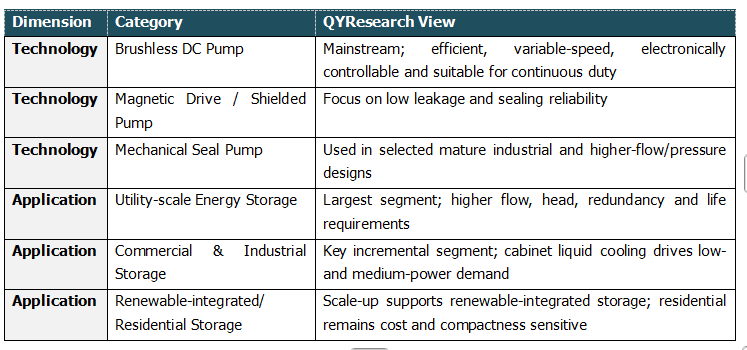
Utility-Scale Storage Remains the Largest Application Segment, While Commercial and Industrial Storage Emerges as the Fastest-Growing Increment
By application, utility-scale energy storage is currently the largest downstream segment, where large containerized systems require stronger flow, head, redundancy, and lifetime performance. The IEA reported approximately 87 GW of utility-scale battery storage additions globally in 2025, confirming that large projects dominate new battery storage deployment. Commercial and industrial storage is becoming a major incremental market as battery cabinets shift from air cooling toward liquid cooling, increasing demand for compact low- and medium-power electronic pumps. Integrated liquid-cooled cabinets are gaining relevance in industrial parks, commercial buildings, microgrids, and distributed renewable applications, creating demand for smaller, more modular pumps and greater opportunities for standardized electronic circulation pump platforms. Renewable-integrated storage benefits from the scale-up of solar-plus-storage and wind-plus-storage projects, while residential storage remains more cost-sensitive and adopts liquid cooling mainly in higher-capacity and highly integrated products. The fastest-growing opportunities are expected in high-energy-density containerized systems, integrated commercial and industrial cabinets, and intelligent pump modules with variable-speed control and condition monitoring.2(11JXGK9(BS$S5}9K.webp)
China Accounts for Approximately 60% of Global Battery Storage Additions, Anchoring Its Position as Both the Largest Demand Market and Manufacturing ClusterThe global production and consumption pattern is strongly clustered by region. China is the largest demand and manufacturing hub, combining the world’s most active new energy storage build-out with a broad supply chain for electronic pumps, motors, controllers, thermal-management components, and energy storage system integration. The IEA estimates that China accounted for around 60% of global battery storage capacity additions in 2025. North America remains a major high-value demand market for large-scale storage, with strong requirements for certification, extreme-temperature operation, and long-term reliability. The U.S. Energy Information Administration reported approximately 15 GW of utility-scale battery storage added in the United States in 2025, with developers planning around 24 GW of additions in 2026. Europe combines growing storage deployment with a mature high-efficiency pump and thermal-management engineering base, with suppliers such as Concentric and Rheinmetall operating established electric coolant-pump platforms. Australia and parts of the Middle East are emerging as important incremental markets, with high-temperature operation becoming a particularly important product requirement in the Middle East. Future regional opportunities will be shaped by China’s scale and cost advantages, North America’s project pipeline and localization needs, and Europe’s extension of high-reliability pump technologies into energy storage and other industrial liquid-cooling applications.YF.webp)
Value Creation Shifts from Pump Hardware to System Matching, Qualification Depth, and Platform-Based Co-EngineeringUpstream inputs for Energy Storage Liquid Cooling Pumps include brushless motors, permanent-magnet materials, bearings, impellers, pump housings, engineering plastics and metals, electronic controllers, sensors, connectors, sealing or shielding structures, and corrosion-resistant and insulating materials. Component quality directly influences pump efficiency, noise, leakage risk, vibration resistance, and operating life, while long-term exposure to water-glycol and other battery-storage coolants makes material compatibility and corrosion resistance essential. Value creation is concentrated less in raw materials than in hydraulic design, motor matching, control algorithms, controller development, seal-less or sealed architecture, coolant-compatibility testing, thermal cycling, vibration validation, and co-development with energy storage integrators. The key entry barrier is customer qualification and long-term reliability validation, typically involving prototype testing, flow and head matching, noise and vibration testing, coolant compatibility, environmental testing, communication verification, and full-system commissioning. The supply chain is gradually shifting from purchasing a stand-alone pump toward modular procurement of pump, motor, controller, sensors, and diagnostic software, raising the value of platform-based suppliers with system co-engineering capability. Persistent ESS cost reduction creates price pressure on standardized pump hardware, but suppliers capable of combining scale manufacturing with application-specific engineering are better positioned to capture value as competition moves from pump price alone toward system matching, validation depth, control interfaces, platform coverage, customization speed, and local technical support.
Data source: This article is based on survey data and analysis from the report Global Energy Storage Liquid Cooling Pumps Market 2026 by Manufacturers, Regions, Type and Application, Forecast to 2032 published by Market Monitor global.
Why Choose Us?

Innovative solutions
Deliver practical and innovative solutions for complex business challenges.

Comprehensive data analysis
Conduct comprehensive data analysis to dig out valuable business insights.

Rich research experience
Possess rich research experience across multiple industry verticals.

Sharp market insight
Maintain sharp market insight to capture emerging industry trends timely.
Call:
+1-3236076188 Know More About Us >>

