 +1-3236076188
 sales@marketmonitorglobal.com

 Log In
 Log In
Home>News>Small Brushless DC Motors: A US$10.76 Billion Market by 2032 as Robotics and Medical Devices Drive Precision Demand
Small Brushless DC Motors: A US$10.76 Billion Market by 2032 as Robotics and Medical Devices Drive Precision Demand
Wednesday,18 Nov,2026
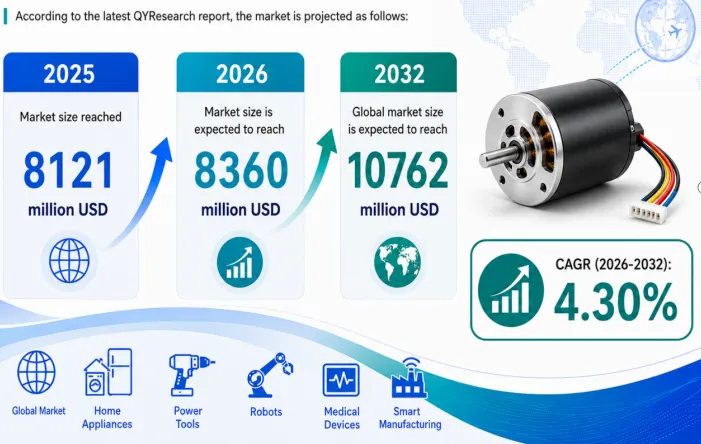
The global small brushless DC motor market was estimated at US$8.121 billion in 2025, rising to US$8.360 billion in 2026 and projected to reach US$10.762 billion by 2032, representing a CAGR of approximately 4.30% from 2026 to 2032, according to 「 Market Monitor global 」's report Global Small Brushless DC Motor Market Size Outlook 2026-2032. The scope covers motors with rated output up to 1 kW and an outside diameter no greater than approximately 100 mm, including bare motors, electronically commutated motors, slotless or coreless motors, flat motors and brushless gearmotors. The average unit value implied by the market size and shipment base places small BLDC motors in a broad price band spanning single-digit dollars for high-volume appliance and power-tool units to several hundred dollars for precision medical and robotics platforms. Growth is not uniform across this band: premium segments tied to robotics, medical devices, and automotive electronics are expanding faster than mature appliance and audio-visual applications, and competition is concentrating on power density, motor diameter, rotational speed, noise, thermal management, drive integration, and cost.
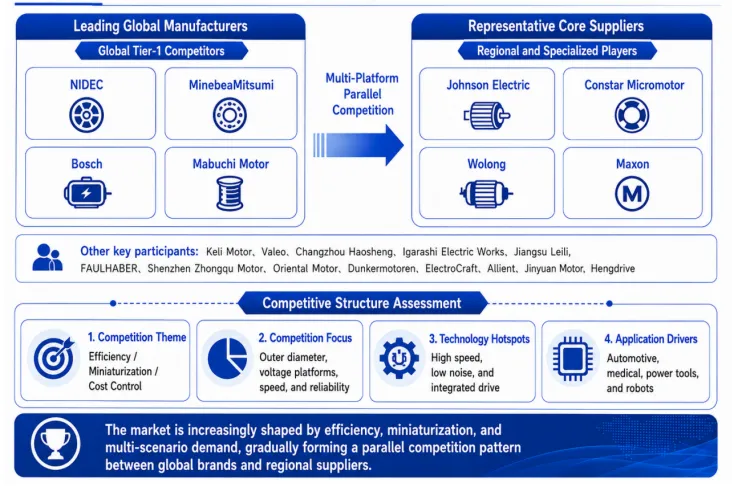
NIDEC, MinebeaMitsumi, Johnson Electric, Bosch and Mabuchi anchor the premium and high-volume tiers of a fragmented global supplier field
The competitive landscape features parallel competition among international motor groups, diversified component companies, and specialized regional manufacturers. NIDEC, MinebeaMitsumi, Johnson Electric, Bosch, and Mabuchi Motor hold important positions in premium and high-volume markets through manufacturing scale, brand strength, technical experience, and broad customer bases. These five suppliers collectively address the majority of high-volume applications in home appliances, automotive electronics, and power tools, where unit cost, supply reliability, and platform standardization matter more than bespoke engineering. A second tier—Maxon, ConStar Micromotor, Keli Motor, and various Chinese suppliers—differentiates through miniaturization, high-speed performance, customization, and cost competitiveness, targeting medical devices, robotics, and specialized industrial equipment where design cycles are longer and performance requirements more specific. Competition is shifting from raw efficiency and power density toward outer diameter reduction, operating voltage flexibility, noise suppression, service life, and integrated drive control, with rapid development cycles and localized supply capability becoming increasingly important as robotics and medical device customers demand shorter time-to-market and regional sourcing.
Outer-rotor designs serve low-speed torque applications while inner-rotor configurations dominate high-speed compact equipment
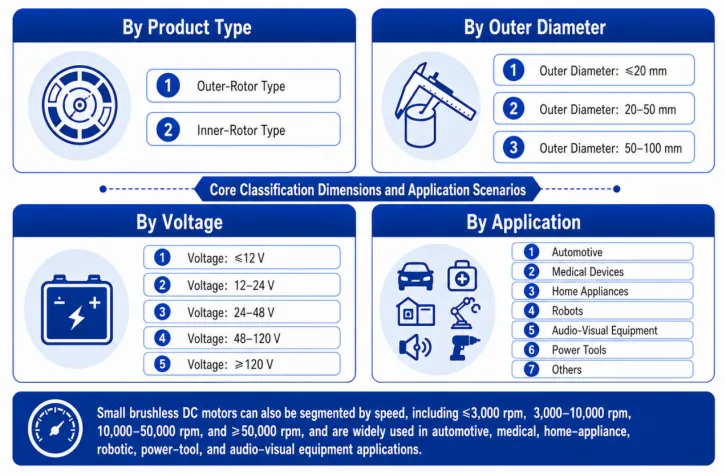
By product type, the market divides into outer-rotor and inner-rotor designs. Outer-rotor motors provide favorable low-speed torque and thermal characteristics, making them well suited to direct-drive applications in home appliances, fans, and certain robotics joints where gear reduction adds cost and complexity. Inner-rotor motors are better suited to high-speed and compact equipment, including medical handpieces, power tools, and precision automation, where rotational speed and diameter constraints are the primary design drivers. By outer diameter, products segment into ≤20 mm, 20–50 mm, and 50–100 mm, with the ≤20 mm category commanding the highest unit values and the tightest manufacturing tolerances. Voltage categories span ≤12 V, 12–24 V, 24–48 V, 48–120 V, and ≥120 V, while speed ranges extend from ≤3,000 rpm to ≥50,000 rpm. The fastest-growing combinations are small-diameter, high-speed inner-rotor designs for medical and robotics applications, and integrated drive-electronics packages that reduce customer assembly complexity and shorten design cycles.
Automotive, medical devices, home appliances, robotics and power tools form five distinct demand pools with divergent growth trajectories
Major applications include automotive, medical devices, home appliances, robots, audio-visual equipment, and power tools. Automotive electronics represents the largest volume pool, driven by electrification, active grille shutters, pumps, and thermal-management actuators that require compact, efficient, and long-life drives. Home appliances constitute a mature but high-volume segment where BLDC penetration continues to rise on energy-efficiency regulation, particularly in fans, compressors, and circulation pumps. Medical devices demand the highest performance and reliability per unit, with small-diameter, low-noise, high-speed motors commanding premium pricing in surgical handpieces, diagnostic equipment, and drug-delivery systems. Robotics—both industrial and service—is the fastest-growing application, requiring high torque density, precise control, and integrated drive electronics for joint actuation and end-effector positioning. Power tools represent a stable, replacement-driven segment where brushless designs have largely displaced brushed motors in professional-grade products, with competition centered on cost and battery compatibility.
Asia-Pacific anchors the global supply chain, while North America and Europe sustain premium demand for miniaturized and high-reliability motors
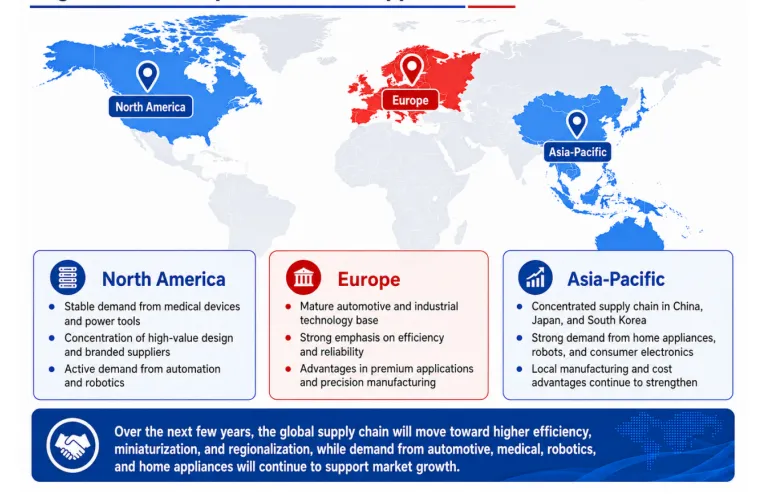
The global market is concentrated in North America, Europe, and Asia-Pacific, with each region playing a distinct role. Asia-Pacific, especially China, Japan, and South Korea, has a highly developed supply chain covering motors, magnetic materials, electronic components, and home appliances, and serves as the primary manufacturing base for high-volume applications. China's domestic supplier base has expanded rapidly in cost-competitive segments, while Japanese and South Korean firms retain strength in precision components and premium motor platforms. North America maintains stable demand from medical devices, power tools, robotics, and high-value automation equipment, with strong requirements for performance, miniaturization, and reliability that favor suppliers with established qualification records. Europe benefits from a mature automotive and industrial manufacturing base and places significant emphasis on efficiency, low noise, long service life, and precise control, particularly in premium automotive and industrial applications. The regional opportunity map is therefore differentiated: Asia-Pacific for volume manufacturing and cost-driven localization, North America for medical and robotics premium demand, and Europe for automotive and industrial efficiency upgrades.
Value concentrates in magnetic materials, rotor-stator assemblies, drive-control systems, and precision manufacturing rather than in assembly labor
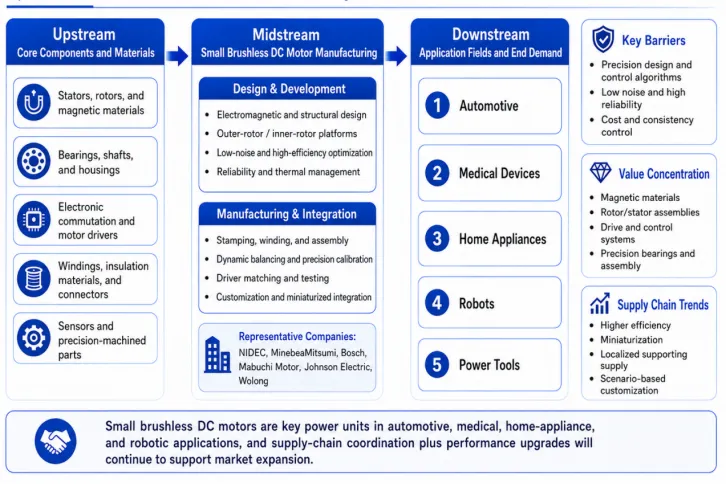
The industry chain consists of upstream materials and core components, midstream motor design, manufacturing and integration, and downstream end-use applications. Key upstream inputs include permanent magnets, electrical steel, copper wire, stators, rotors, bearings, shafts, housings, electronic commutation devices, motor drivers, insulation materials, connectors, sensors, and precision-machined parts. Midstream manufacturers focus on electromagnetic and structural design, outer-rotor and inner-rotor platforms, thermal management, low-noise optimization, drive matching, winding, stamping, dynamic balancing, assembly, and testing. Value concentrates in magnetic materials, rotor-stator assemblies, drive-control systems, and precision manufacturing—not in assembly labor. Rare-earth magnet prices and electrical steel costs directly influence motor cost structure, while drive-control integration is increasingly where suppliers differentiate: a motor with integrated electronics commands a higher price and creates switching costs for customers. As demand expands in robotics, medical devices, and automotive electronics, platform-based design and localized supply capabilities will become increasingly important competitive advantages, and suppliers that can combine magnetic-material expertise, precision manufacturing, and drive-electronics integration will be best positioned to capture premium segment growth.
Data source: This article is written based on survey data and analysis from the report Global Small Brushless DC Motor Market Size Outlook 2026-2032 published by 「 Market Monitor global 」.
Why Choose Us?

Innovative solutions
Deliver practical and innovative solutions for complex business challenges.

Comprehensive data analysis
Conduct comprehensive data analysis to dig out valuable business insights.

Rich research experience
Possess rich research experience across multiple industry verticals.

Sharp market insight
Maintain sharp market insight to capture emerging industry trends timely.
Call:
+1-3236076188 Know More About Us >>

