 +1-3236076188
 sales@marketmonitorglobal.com

 Log In
 Log In
Home>News>Tidal Stream Turbine Market Reaches US$58.20 Million in 2025, Forecast to Hit US$169.47 Million by 2032 at 14.20% CAGR
Tidal Stream Turbine Market Reaches US$58.20 Million in 2025, Forecast to Hit US$169.47 Million by 2032 at 14.20% CAGR
Thursday,19 Nov,2026
Global Market Forecast: US$58.20 Million (2025) to US$169.47 Million (2032), 14.20% CAGR
The global tidal stream turbine market was valued at approximately US$58.20 million in 2025 and is projected to reach about US$169.47 million by 2032, representing a compound annual growth rate of approximately 14.20% during 2026–2032, according to Market Monitor global's survey data and analysis in the report Global Tidal Stream Turbine Market 2026 by Manufacturers, Regions, Type and Application, Forecast to 2032. The market scope covers complete turbine units and directly integrated power conversion, controls and monitoring, fixed or floating support structures, and subsea electrical interfaces. The 2025 average unit price is approximately US$3–8 million per complete unit, with an industry average gross margin of approximately 25%–40%.
Demand growth is anchored in ring-fenced revenue support in the United Kingdom and Europe, French pre-commercial farms, China's scale-up of marine-energy demonstrations, high-energy Canadian sites, and demand for predictable local electricity in islands, remote coastal communities and offshore infrastructure. Ocean Energy Europe reported in 2025 that 152 MW of tidal stream capacity across 11 pre-commercial farms was scheduled for deployment over the following five years, signaling a transition from single-device validation toward array-scale delivery. The market remains in an early commercialization phase shaped by public support and project timing.
6(Z$(479(~KX.webp)
Competitive Landscape: Orbital Leads with 32 MW Cumulative Orderbook; MeyGen Phase 1 at 6 MW Operational
The global supplier base remains relatively small, and the industry has not yet established a stable standardized mass-production model. Project awards, long-term operating data and bankability determine competitive strength more directly than nominal manufacturing capacity.
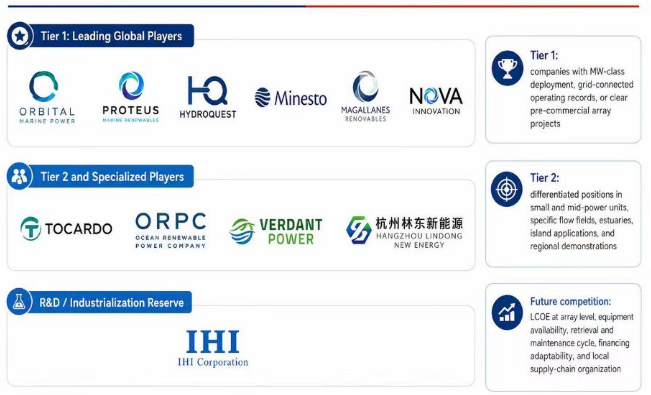
Orbital Marine Power holds the most visible commercial pipeline. Its UK CfD project portfolio reached 17 MW following Allocation Round 7, and a power purchase agreement with Nova Scotia equates to an order for six additional turbines (approximately 15 MW) for the Bay of Fundy. Between the UK and Canada, Orbital's cumulative orderbook stands at 32 MW, or thirteen turbines. The company's existing 2 MW O2 turbine has been grid-connected in Orkney since 2021, and a 9.2 MW EURO-TIDES array featuring three next-generation 2.4 MW O2-X turbines is planned for 2028.
Proteus Marine Renewables completed offshore maintenance and upgrade operations at the MeyGen project in Scotland's Pentland Firth in December 2025, involving five turbine interventions in three days. MeyGen Phase 1 comprises a 6 MW array with four 1.5 MW turbines; Phase 2 has been allocated 59 MW with planned commissioning in 2027, 2028 and 2029. Proteus also installed a 1.1 MW turbine in Japan's Naru Strait.
HydroQuest, through the FloWatt project at Raz Blanchard, is advancing a 17 MW pilot farm comprising six vertical-axis turbines, with commissioning scheduled for late 2028. France's third Pluriannual Energy Program includes a 250 MW tidal tender to be awarded by 2030, with a ceiling price of €160/MWh. Minesto operates the 500 kW Deep Green tidal kite at Vestmanna in the Faroe Islands, grid-connected since 2020. Magallanes Renovables secured project finance for its 1.5 MW ATIR 2.0 floating platform, to be built in Vigo and deployed in Scottish waters under a CfD.
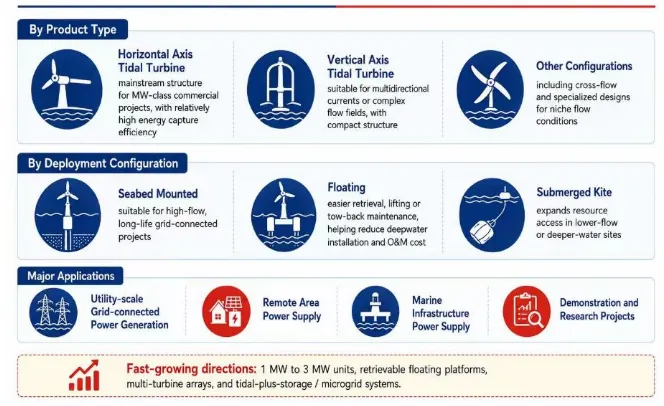
Product Structure: Horizontal-Axis Architecture Dominates Megawatt-Scale Commercial Projects; Floating Platforms Enable Retrieval-Based Maintenance
By product type, horizontal-axis tidal turbines remain the dominant architecture for megawatt-scale commercial projects due to high capture efficiency and an established engineering base. Vertical-axis turbines accommodate changing flow directions and suit multi-directional sites or compact structural designs; HydroQuest's FloWatt deployment exemplifies this configuration. Submerged-kite devices, represented by Minesto's Deep Green technology, amplify relative flow speed to extend the addressable resource to lower-current or deeper-water locations.
By deployment configuration, seabed-mounted turbines suit high-velocity sites with controlled navigation impact and long-term grid projects. Floating turbines integrate the powertrain into a moored platform, enabling improved component access and tow-back maintenance. Orbital's O2 and Magallanes' ATIR platforms are floating configurations; MeyGen uses seabed-founded turbines. Faster-growing directions include 1–3 MW units, retrievable floating platforms, multi-unit arrays and tidal systems integrated with storage and microgrids.
(5L}7H4APIC.png)
Regional Distribution: UK Holds 56.5 MW Secured at Morlais; France Targets 250 MW Tender by 2030
Europe remains the principal region for technology development and pre-commercial demand. The United Kingdom's ring-fenced Contracts for Difference mechanism provides dedicated revenue support. Allocation Round 7 awarded an additional 18.5 MW to the Morlais tidal scheme on Ynys Môn, bringing total capacity secured for the scheme to 56.5 MW, with developers including Hydrowing, QED Naval and Tidal Technologies. HydroWing secured a further 10 MW for its Ynni'r Lleuad project at Morlais, building on 20 MW already awarded; the Phase 3 project is scheduled for delivery in 2030 and will deploy 18 × 1.67 MW devices.
France is advancing industrialisation around the Raz Blanchard. The FloWatt pilot farm targets financial close in 2026 and commissioning in late 2028. Canada's Bay of Fundy offers high-energy resources; Orbital's Nova Scotia power purchase agreements represent approximately 15 MW. China's 2025 multi-ministry guideline called for phased development of the 100 MW-class Zhoushan tidal stream program and encouraged island hybrid energy and offshore-platform applications. Production remains concentrated in Europe, with regional manufacturing capabilities emerging in North America and China.
XQ6`L70GFD.webp)
Upstream Industrial Chain: Composite Blades and Direct-Drive Generators Anchor Value; Lifecycle Services Represent Growing Revenue Share
Upstream inputs include composite blades, corrosion-resistant steels and specialized alloys, marine bearings and seals, shafts, gearboxes or direct-drive permanent-magnet generators, converters and controllers, sensors, subsea cables, wet-mate or dry-mate connectors, foundations, floating structures and mooring systems. Midstream activities cover hydrodynamic design, rotor and nacelle manufacturing, powertrain integration, platform and foundation integration, control software, factory testing, offshore installation, grid commissioning and long-term maintenance.
Key barriers are efficient energy capture under reversing and turbulent flows, long-duration subsea sealing and corrosion resistance, fatigue and extreme-load management, environmental permitting, vessel and installation-window planning, certification and bankable operating data. The highest-value activities are proprietary turbine architecture, powertrain engineering, controls, system integration, reliability validation and lifecycle services. Future supply chains are expected to shift from project-specific fabrication toward modular platforms, standardized interfaces, regional shipyard partnerships and serial procurement. Condition monitoring, predictive maintenance, major-component replacement and array optimization represent a growing share of lifecycle revenue as installed capacity accumulates.
Data source: This article is compiled with reference to the survey data and analysis in the report Global Tidal Stream Turbine Market 2026 by Manufacturers, Regions, Type and Application, Forecast to 2032 released by Market Monitor global.
Why Choose Us?

Innovative solutions
Deliver practical and innovative solutions for complex business challenges.

Comprehensive data analysis
Conduct comprehensive data analysis to dig out valuable business insights.

Rich research experience
Possess rich research experience across multiple industry verticals.

Sharp market insight
Maintain sharp market insight to capture emerging industry trends timely.
Call:
+1-3236076188 Know More About Us >>

