 +1-3236076188
 sales@marketmonitorglobal.com

 Log In
 Log In
Home>News>Non-Invasive Vagus Nerve Stimulators Market to Reach US$79.23 Million by 2032 at 12.5% CAGR, as electroCore Reports Record US$31.8–32.0 Million Revenue in 2025
Non-Invasive Vagus Nerve Stimulators Market to Reach US$79.23 Million by 2032 at 12.5% CAGR, as electroCore Reports Record US$31.8–32.0 Million Revenue in 2025
Tuesday,24 Nov,2026
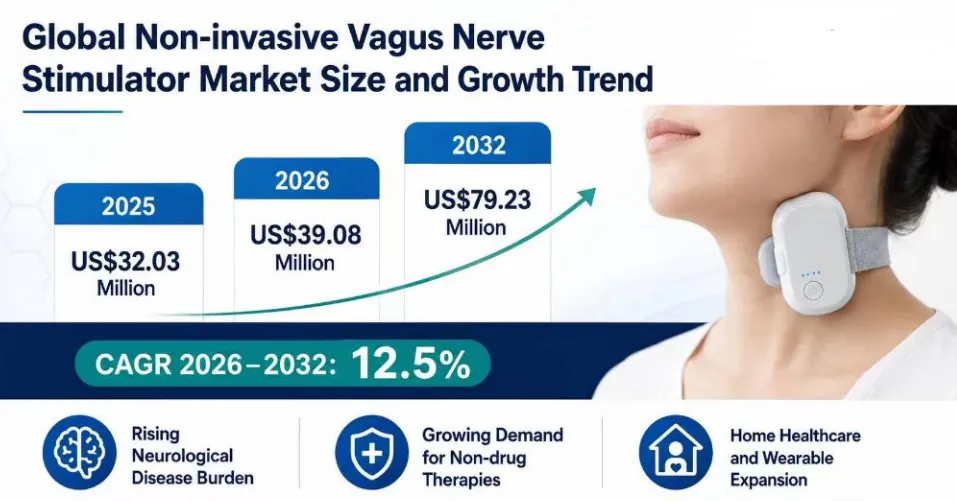
The global non-invasive vagus nerve stimulator market was valued at approximately US$32.03 million in 2025 and is projected to reach US$39.08 million in 2026 and US$79.23 million by 2032, expanding at a CAGR of approximately 12.5% during 2026–2032, according to Market Monitor global’s report Global Non-invasive Vagus Nerve Stimulator Market 2026 by Manufacturers, Regions, Type and Application, Forecast to 2032. The 2025 average selling price stood at approximately US$700–1,200 per unit, with industry gross margins of approximately 35%–50%. Demand is anchored by the substantial global burden of neurological disorders—the World Health Organization reported in 2025 that headache disorders alone affected approximately 3.1 billion people worldwide, or roughly 40% of the global population—and by the accelerating shift toward non-drug, home-based chronic disease management.
electroCore Commands the Cervical Route with Record US$31.8–32.0 Million Revenue in 2025, While tVNS Technologies and Parasym Advance Auricular Platforms
electroCore, Inc. remains the most commercially scaled pure-play in the category, reporting preliminary full-year 2025 revenue of approximately US$31.8–32.0 million, representing approximately 26% growth over full-year 2024 revenue of US$25.2 million. Fourth-quarter 2025 revenue reached approximately US$9.0–9.2 million, up approximately 30% year on year. Its gammaCore platform holds the foundational U.S. regulatory position for the cervical route, with the FDA’s De Novo classification record establishing the pathway for non-invasive vagus nerve stimulation in headache indications. electroCore ended 2025 with total cash, cash equivalents, and marketable securities of approximately US$11.6 million.
tVNS Technologies GmbH differentiates through auricular stimulation and holds a distinctive regulatory position in Europe. Its tVNS E device is described as the only non-invasive vagus nerve stimulator approved as a Class IIa medical device under the EU-MDR, with supporting CB reports facilitating ethics committee approvals for research protocols. The company’s heritage traces to the Cerbomed Nemos device, the world’s first approved non-invasive vagus nerve stimulator, with more than 20 years of research and development behind the platform. The NEMOS device delivers fixed 0.25 ms duration monophasic square wave pulses at 25 Hz, with user-controlled intensity up to 25 V and treatment sessions lasting at least one hour.
Parasym Ltd., operating under the Nurosym brand in Europe and Nuropod in the United States, has built an extensive clinical research program spanning more than 60 completed clinical studies, over 100 ongoing studies, and more than 150 research partners. In clinical studies examined by the company, anxiety fell by an average of 35% and fatigue by 48%, while sleep quality improved by an average of 30%. The Nurosym device uses Parasym’s proprietary AVNT waveform delivered through an earpiece positioned on the tragus, with typical sessions of approximately 30 minutes, once or twice daily. The company launched Nuropod for the U.S. market in September 2025.
Cervical Stimulation Anchors the Regulated Headache Market, While Auricular Devices Drive Home-Based and Mental Health Expansion
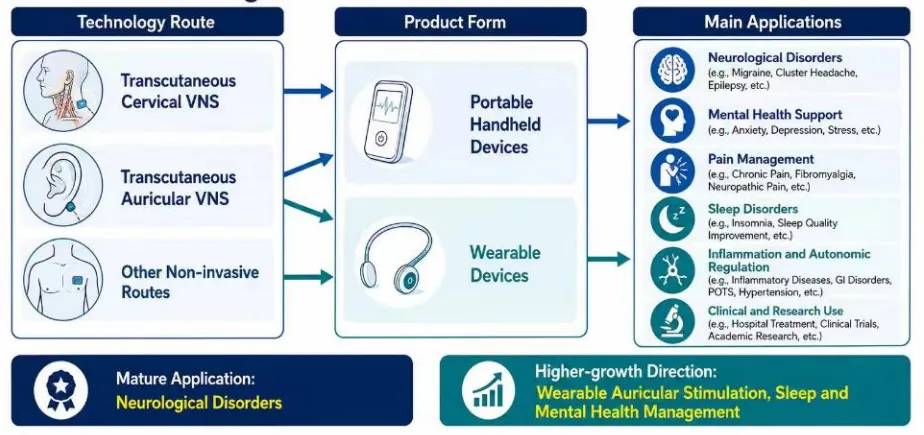
By technology route, transcutaneous cervical vagus nerve stimulation holds the strongest commercialization position, anchored by gammaCore’s FDA pathway and its established use in migraine and cluster headache. These devices are predominantly portable handheld units designed for episodic use under clinical supervision.
Transcutaneous auricular vagus nerve stimulation represents the faster-growing route for home-based and longer-duration applications, targeting the auricular branch of the vagus nerve distributed around the cymba conchae and tragus. The auricular approach is better suited to lower-burden, repeated daily use, supporting expansion into mental health, sleep regulation, and autonomic function improvement. tVNS Technologies’ Class IIa EU-MDR approval and Parasym’s wearable Nurosym platform exemplify the auricular segment’s regulatory and product maturation.
By product form, portable handheld devices remain the largest commercial category, while wearable devices are gaining share as electrode stability, continuous-use comfort, and mobile connectivity improve. The competitive dividing line is increasingly defined by indication-specific clinical evidence, reimbursement pathways, and the ability to capture treatment adherence data rather than hardware specifications alone.
M5LOL3_0Y[PR.webp)
China’s Regulatory Milestone: Hangzhou Wecare’s taVNS Secures NMPA Class II Registration for Primary Sleep Disorders in April 2026
China is emerging as a significant incremental market, with domestic developers advancing both device registration and clinical adoption. Hangzhou Wecare Medical Technology received NMPA Class II medical device registration in April 2026 for its wearable transcutaneous auricular vagus nerve stimulator, indicated for the adjunct treatment of primary sleep disorders. The device has been included in medical service pricing catalogs across multiple Chinese provinces under the electrical stimulation therapy category, with eligibility for Class B medical insurance reimbursement. Its earphone-style wearable design incorporates a self-developed high-elasticity flexible adaptive bracket to accommodate varying auricular morphologies, Bluetooth audio for synchronized acoustic stimulation, and multi-device management for research applications.
The Chinese competitive landscape also includes Jiangsu Yuyue Medical Equipment, which holds a patent for an improved auricular vagus nerve stimulator featuring a detachable electrode design and a T-shaped auricular electrode for improved durability and user cost reduction. Jiangxi XinzhiLe Medical Technology and Hangzhou Yijian Technology are recorded as participants in China’s non-invasive VNS supply chain, with Yijian among the drafting units for the T/HZAS 88-2025 group standard for transcutaneous auricular vagus nerve stimulators, published in November 2025.
South Korea’s NEURIVE Co., Ltd. is advancing a differentiated combination approach. Its Soricle device, a Class III combined medical device integrating transcutaneous vagus nerve stimulation with sound stimulation, has been evaluated in a prospective, single-center, randomized, double-blind, sham-controlled exploratory clinical trial for subjective tinnitus, enrolling 36 participants over an 8-week daily-use protocol. A separate open-label study examining bilateral taVNS combined with auditory cues in Parkinson’s disease patients with freezing of gait reported a reduction in mean freezing episodes from 1.7 ± 1.6 at baseline to 0.3 ± 0.48 at the combined intervention visit, though the authors characterized the findings as preliminary and requiring controlled investigation.
GOCHLL_)GYC}BN{[2]7.webp)
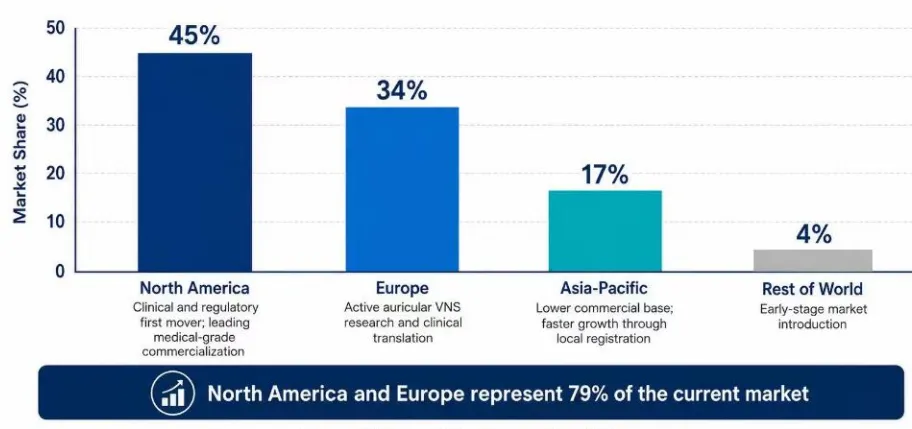
North America and Europe Lead Clinical Infrastructure and Reimbursement Pathways, While Asia-Pacific Builds Manufacturing and Registration Capabilities
North America retains the most developed commercial infrastructure for non-invasive VNS, anchored by electroCore’s U.S. revenue base, the FDA’s established De Novo and 510(k) pathways for the cervical route, and physician familiarity with neuromodulation for headache management. The region’s competitive dynamic is shaped by prescription-based reimbursement and specialty channel access, creating barriers for home-use auricular devices that lack established coverage.
Europe combines active auricular VNS research with a regulatory framework that has enabled Class IIa approvals under EU-MDR. tVNS Technologies’ Class IIa position and Parasym’s CE-marked Nurosym platform provide a foundation for clinical adoption, while NICE health-technology assessment activity in the United Kingdom illustrates progress in reimbursement evaluation for representative products.
Asia-Pacific is earlier in commercialization but building capacity rapidly. China’s NMPA Class II registration for taVNS and its inclusion in provincial reimbursement catalogs signal a pathway toward clinical adoption at scale, supported by the country’s medical-device manufacturing base and electronics supply chain. South Korea contributes device innovation through NEURIVE’s combination approaches and clinical trial activity.
Value Concentrates in Stimulation Precision, Clinical Evidence, and Reimbursement Access as the Market Transitions from Validation to Home-Based Chronic Care
Upstream inputs include electronic components, medical-grade electrode materials, semiconductors, batteries, and waveform-control and signal-processing technologies. Midstream activities span stimulator hardware design, parameter algorithms, electrode architecture, clinical validation, regulatory submissions, and treatment-management software. The principal barriers are not in standard electronic components but in target accuracy and parameter stability, consistent electrode contact across anatomical variation, indication-specific clinical evidence, medical-device compliance, and long-term patient adherence.
The supply chain is moving toward miniaturized wearable form factors, modular electrode designs, tighter hardware-software integration for remote follow-up, and localized registration and service capabilities. electroCore’s 26% revenue growth in 2025 demonstrates that the cervical prescription channel can scale when supported by established reimbursement and physician familiarity. The auricular segment’s trajectory will depend on whether home-use devices can secure coverage pathways comparable to those available for prescription neuromodulation, and on the accumulation of randomized controlled evidence beyond the pilot and exploratory studies that currently characterize much of the clinical literature.
Data source: This article is based on survey data and analysis from the report Global Non-invasive Vagus Nerve Stimulator Market 2026 by Manufacturers, Regions, Type and Application, Forecast to 2032 published by Market Monitor global.
Why Choose Us?

Innovative solutions
Deliver practical and innovative solutions for complex business challenges.

Comprehensive data analysis
Conduct comprehensive data analysis to dig out valuable business insights.

Rich research experience
Possess rich research experience across multiple industry verticals.

Sharp market insight
Maintain sharp market insight to capture emerging industry trends timely.
Call:
+1-3236076188 Know More About Us >>

