 +1-3236076188
 sales@marketmonitorglobal.com

 Log In
 Log In
Home>News>Global Benefits Administration Software Market to Reach USD 1.19 Bn in 2026 and USD 1.90 Bn by 2032 at 8.1% CAGR
Global Benefits Administration Software Market to Reach USD 1.19 Bn in 2026 and USD 1.90 Bn by 2032 at 8.1% CAGR
Friday,27 Nov,2026
Market Monitor global’s report on benefits administration software estimates the global market size at USD 1.11 billion in 2025, USD 1.19 billion in 2026, and forecasts USD 1.90 billion by 2032, with an 8.1% CAGR from 2026 to 2032. Benefits administration software is a digital platform for planning, configuration, operation and analysis of employee benefit programs, covering medical insurance, pension plans, leave, maternity benefits and other welfare items. It automates benefit enrollment, eligibility checking, vendor collaboration and cost control, and supports employee self-service and centralized benefit scheme management. Downstream demand comes from enterprises pursuing efficiency improvement and cost optimization, pushing the industry toward intelligence, integration and service-oriented development. This analysis covers market scale, competitive tiers, deployment modes, application structure, regional layout and industrial chain value distribution.
}{P3ARA3JJ9_~M52T$1.webp)
2026 Competitive Landscape: Workday, ADP, Ceridian Lead the First Tier; Specialized Vendors and Regional Suppliers Enrich the Market Matrix
The market has moderate concentration, consisting of comprehensive HCM platform providers, professional benefits administration specialists and local regional vendors. Core global players include Workday, ADP, WEX Health, Benefitfocus, Bswift, Namely, TriNet, Paycom, EmpowerHR/Pay and Ceridian (Dayforce). First-tier suppliers such as Workday, ADP and Ceridian (Dayforce) own complete human capital management ecosystems, global service capacity and large enterprise client bases, delivering integrated solutions combining benefits, payroll, HCM and data analytics for multinationals and large organizations. Second-tier vendors including Benefitfocus, Bswift, WEX Health and Namely focus on benefits management, payroll or vertical sectors, gaining advantages through flexible configuration, specialized functions and localized services. New entrants and regional players adopt cloud, AI and workflow automation plus local compliance capabilities, mainly targeting SMEs and regional markets. Competition is shifting from standalone enrollment tools to integrated employee experience platforms. Future differentiation hinges on AI decision support, automatic benefit configuration, advanced analytics, cloud-native architecture and deep linkage with payroll and HCM systems.
]N3RE4R~_5C1S.webp)
2026 Product & Demand Structure: Cloud-based SaaS Becomes the Fastest-growing Segment; Large Enterprises and SMEs Have Divergent Needs
By deployment model, the market is split into on-premise and cloud-based solutions. On-premise software is deployed on enterprise internal servers, granting users full data ownership and high customization, suitable for large groups and companies with strict data security and compliance requirements. Cloud-based SaaS benefits administration software features flexible deployment, low maintenance cost, easy upgrades and remote access; it is the fastest-growing track driven by digital transformation. From the application side, large enterprises tend to select all-in-one platforms to realize multi-region unified management, benefit provider coordination and cross-system integration. SMEs prefer standardized, lightweight cloud products to cut management costs and simplify operation. The incremental demand will mainly come from SME digital adoption, large enterprise system upgrade and the fusion of AI, analytics and HR platforms.
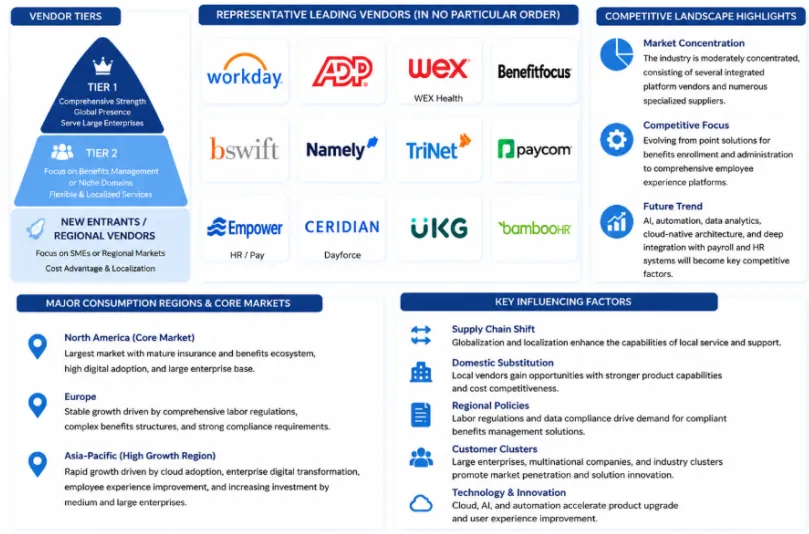
2026 Regional Layout: North America Is the Most Mature Core Market; Asia-Pacific Is the Fastest-growing Region
North America, Europe and Asia-Pacific are the major supply and consumption regions. The United States is the most mature market with abundant leading HCM vendors, a sound insurance and welfare ecosystem and high digital penetration. Europe, represented by the UK, Germany and France, has solid foundations in compliance management and multinational employee welfare digitalization, supported by sound labor laws and complex benefit systems. Asia-Pacific including China, Japan, India and Singapore grows rapidly, fueled by enterprise digital transformation and demand for localized HR systems, with emerging regional supplier clusters. North America and Europe remain the dominant consumption markets, while Asia-Pacific stands out as a high-growth area driven by cloud adoption, employee experience upgrading and rising HR digital investment from mid-to-large companies.
Industrial Chain Layout: Upstream Cloud Infrastructure & Security Technologies Underpin Platforms; Midstream Integrators Create Core Solution Value
The value chain is divided into upstream basic technologies, midstream platform developers and downstream enterprise users. Upstream covers cloud infrastructure, storage, databases, AI analytics, cybersecurity and underlying HRM/HCM modules, where cloud resources, data security and integration capability are critical foundations. Midstream suppliers design software architecture, develop functional modules, and connect with payroll, attendance, insurance vendors and third-party systems to realize benefit plan configuration, enrollment, eligibility verification, cost analysis and report output. Downstream buyers include large enterprises, SMEs, multinational companies and public institutions. Large groups prioritize unified multi-region governance, system interconnection and compliance control; SMEs focus on low cost, fast launch and ease of use. Core barriers include platform R&D strength, privacy and compliance capability, system integration, enterprise customer resources and ecosystem partnerships. High-value links concentrate on platform capability, data analytics, system integration and continuous after-sales service. The whole chain is evolving toward cloud-native, intelligent and ecosystem-centric models.
Risks and Commercial Opportunities
Key risks include uneven digital maturity among enterprises, complicated cross-border regulatory differences, high system migration costs, and tightening personal data privacy rules. Core opportunities lie in global welfare management for multinationals, lightweight SaaS deployment for SMEs and cross-regional compliance management. Vendors with global service networks, robust ecosystem integration and localized compliance adaptation will widen their advantages. Driven by enterprise demands for better employee experience, lower welfare management expense and intelligent HR transformation, benefits administration software will be further integrated with payroll, HCM platforms, insurance agencies and financial systems, with long-term positive outlook.
Data source: This article is compiled with reference to the survey data and analysis in the corresponding industry report released by Market Monitor global.
Why Choose Us?

Innovative solutions
Deliver practical and innovative solutions for complex business challenges.

Comprehensive data analysis
Conduct comprehensive data analysis to dig out valuable business insights.

Rich research experience
Possess rich research experience across multiple industry verticals.

Sharp market insight
Maintain sharp market insight to capture emerging industry trends timely.
Call:
+1-3236076188 Know More About Us >>

